Understanding Paper Selection for Effective Document Organization
In the digital age, the strategic selection of paper remains a cornerstone of efficient physical document organization. This guide explores the various facets of paper choice, moving beyond mere aesthetics to focus on functionality, longevity, and how different paper types contribute to a well-managed information system. As we navigate the complexities of record-keeping in 2026, understanding the fundamental properties of paper becomes increasingly vital for creating accessible, durable, and easily navigable physical archives.
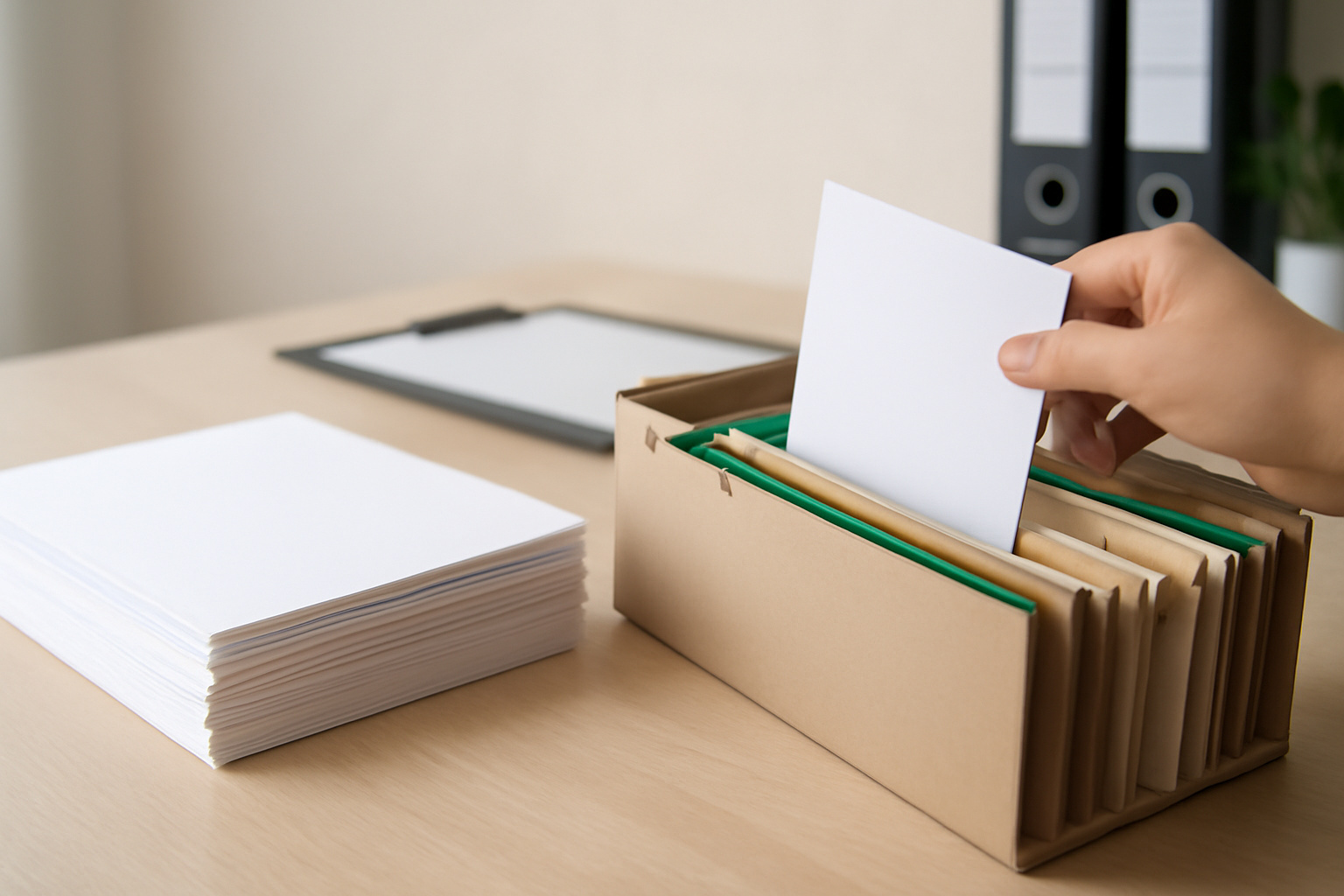
The Importance of Paper in Physical Information Management
While digital solutions dominate many aspects of modern life, the necessity of physical documents persists across numerous sectors, from legal and academic institutions to personal record-keeping. The tangible nature of paper offers unique benefits, including a distinct sense of permanence and accessibility that can be crucial for certain types of information. However, the effectiveness of these physical documents is intrinsically linked to the quality and type of paper used. Selecting the right paper impacts not only the clarity and readability of the content but also its durability, archival potential, and ease of handling. Incorrect paper choices can lead to issues such as ink bleed-through, premature degradation, difficulty in filing, and ultimately, a disorganized and inefficient system. Therefore, a thoughtful approach to paper selection is an investment in the long-term usability and integrity of physical records.
In 2026, the principles of document organization are as relevant as ever. While technology continues to advance, the fundamental need for reliable physical records remains. This guide aims to demystify the process of choosing paper for efficient document organization, focusing on practical considerations rather than commercial endorsements. We will explore the key characteristics of paper that influence its suitability for various organizational needs, discuss the long-term implications of these choices, and provide a framework for making informed decisions.
Evaluating Paper for Document Organization: Key Characteristics
The selection of paper for organizational purposes involves understanding several key characteristics that define its performance and suitability. These properties are not merely technical specifications but directly influence how well documents can be stored, accessed, and preserved over time.
1. Weight and Thickness (Basis Weight and Caliper)
Paper weight is typically measured by its basis weight, which refers to the weight of a ream (500 sheets) of a standard size for that particular grade of paper. In the United States, this is often expressed in pounds (e.g., 20 lb, 24 lb, 28 lb). A higher basis weight generally indicates a thicker and more substantial paper. Closely related is the caliper, which measures the actual thickness of a single sheet of paper in mils (thousandths of an inch) or millimeters. For document organization, a paper that is too thin might be prone to tearing, show ink bleed-through from the other side, or warp easily, especially when handled frequently or stored in large volumes. Conversely, overly thick paper can increase the bulk of files, making them harder to manage and store efficiently. A common standard for everyday documents, such as 20 lb bond, offers a balance of readability and manageability. For documents that require more durability or are expected to be handled frequently, such as reports, presentations, or archival materials, a heavier weight (e.g., 24 lb or 28 lb) might be more appropriate. The choice here often involves a trade-off between bulk and durability.
2. Brightness and Whiteness
Brightness refers to the amount of light a paper reflects, measured on a scale typically from 0 to 100. Higher brightness levels (e.g., 90-98) result in a whiter, more vibrant appearance, which can enhance the contrast of printed text and images, making them easier to read. This is particularly important for documents that need to be scanned or viewed under various lighting conditions. Whiteness, on the other hand, relates to the color of the paper. Papers can range from a cool, blue-white to a warm, yellowish-white. For organizational purposes, a neutral or slightly cool white is often preferred as it minimizes eye strain and provides a clean backdrop for text. However, extremely high brightness papers can sometimes cause glare, and very bright white papers might not be ideal for all printing technologies. For archival purposes, papers with lower, more natural brightness and whiteness might be considered to avoid potential chemical interactions over extended periods, though modern brighteners are generally stable.
3. Opacity
Opacity is the measure of a paper's ability to prevent light from passing through it. It is often expressed as a percentage. High opacity is desirable for efficient document organization because it minimizes bleed-through and show-through. Bleed-through occurs when ink seeps through the paper, while show-through is when the printed image on one side is visible from the other. This is especially crucial when printing on both sides of a sheet (duplex printing) or when using inks that are prone to bleeding, such as those from some inkjet printers. Papers with higher opacity ensure that printed content remains clear and legible on each side, reducing the need for thicker paper stocks to compensate and allowing for more information to be stored per sheet without compromising readability. Standard copy paper typically has good opacity, but for critical documents or those intended for extensive archiving, papers with enhanced opacity might be a beneficial consideration.
4. Smoothness and Texture
The smoothness of a paper's surface affects how ink transfers and how it feels to the touch. Smoother papers generally allow for sharper print definition, especially with inkjet printers, as the ink droplets are less likely to spread. They also tend to feel more substantial and professional. However, excessively smooth papers can sometimes be slippery, making them difficult to handle or prone to smudging if the ink has not fully dried. Conversely, papers with a more textured surface can offer a distinct aesthetic and a more tactile experience. For general document organization, a moderately smooth paper provides a good balance of print quality and handling ease. Papers with a noticeable tooth or texture might be less ideal for high-volume printing or where crisp, precise text is paramount, but they can be useful for specific types of creative or artistic documents where texture is a desired element.
5. Acidity (pH Level) and Archival Quality
A critical factor for long-term document preservation is the paper's acidity. Traditional papermaking often used alum rosin sizing, which is acidic. Over time, this acid breaks down the cellulose fibers in the paper, causing it to become brittle, yellow, and eventually disintegrate. Modern papermaking has largely shifted to using alkaline sizing (e.g., calcium carbonate or calcium hydroxide), which creates acid-free paper. Acid-free paper has a pH of 7.0 or higher. Archival quality paper is typically acid-free and often buffered with an alkaline reserve (e.g., calcium carbonate) that can neutralize acids that might develop over time or be absorbed from the environment. Such paper is designed to last for centuries under normal storage conditions. For documents intended for long-term retention, such as legal records, historical documents, or important personal papers, investing in acid-free, archival-quality paper is paramount to ensuring their survival. Always look for designations like "acid-free," "archival," or a pH rating when selecting paper for preservation purposes.
6. Fiber Content
The primary component of most paper is cellulose fiber, typically derived from wood pulp. Wood pulp can be either softwood (longer fibers, e.g., pine, spruce) or hardwood (shorter fibers, e.g., oak, maple). Papers made with a higher proportion of softwood fibers tend to be stronger and more durable due to the longer fibers, making them suitable for documents requiring resilience. Cotton fiber paper, often called rag paper, is exceptionally strong, durable, and has excellent archival properties because cotton fibers are naturally strong and free from the lignin found in wood pulp, which can degrade over time. While more expensive, cotton paper is often used for important documents like legal certificates, diplomas, and fine art prints where extreme longevity and strength are required.
Categorizing Paper for Organizational Needs
Understanding the characteristics of paper allows for a more nuanced approach to categorizing paper types based on their intended organizational use. This categorization helps in making practical choices that align with the document's purpose and expected lifespan.
Everyday Document Paper
For routine office tasks, interoffice memos, drafts, and general correspondence, standard copy paper is typically sufficient. This is usually a bright white, wood-pulp paper with a basis weight of around 20 lb and a moderate level of opacity and smoothness. It offers a good balance of cost-effectiveness and performance for high-volume printing and everyday handling. Its longevity is generally not a primary concern, as these documents are often transient.
Presentation and Report Paper
Documents that are intended to be presented to others, such as reports, proposals, or training materials, benefit from paper that conveys a sense of quality and professionalism. These papers are often slightly heavier (e.g., 24 lb or 28 lb basis weight), may have a higher brightness, and can sometimes feature a smoother finish for enhanced print clarity. While not necessarily archival, they are designed for durability through multiple readings and handling.
Archival and Preservation Paper
For documents that need to be preserved for extended periods, such as legal deeds, historical records, important personal documents, or master copies, archival-quality paper is essential. These papers are characterized by being acid-free, often with a buffered alkaline reserve, and possess high opacity and good strength. They are typically made from high-quality wood pulp or cotton fibers. The investment in archival paper ensures that these critical documents can withstand the test of time without significant degradation.
Specialty Papers
Certain organizational needs might call for specialty papers. For instance, thicker cardstock might be used for dividers, labels, or index cards, providing rigidity and durability. Papers with specific finishes, such as matte or glossy, might be chosen for visual impact in certain types of reports, though their organizational utility might be secondary to their aesthetic qualities.
Here is a comparison of common paper types relevant to document organization:
| Paper Type | Typical Basis Weight (lb) | Brightness Range | Opacity | Key Organizational Benefit | Primary Use Case |
|---|---|---|---|---|---|
| Standard Copy/Multipurpose Paper | 18-20 | 86-94 | Good | Cost-effective, general use | Everyday printing, drafts, internal memos |
| Presentation/Report Paper | 24-28 | 90-97 | Very Good | Enhanced durability and feel | Reports, proposals, external documents |
| Cardstock/Cover Stock | 65-110 (Cover) / 100-200 (Index) | Varies | Excellent | Rigidity, durability for separation | Dividers, covers, index cards, signage |
| Archival/Acid-Free Paper | 20-24 (or thicker) | 80-90 (often less bright for stability) | Very Good to Excellent | Long-term preservation, resistance to degradation | Legal documents, historical records, permanent archives |
| Cotton (Rag) Paper | 24-32 (or thicker) | 85-95 | Excellent | Extreme durability, longevity, archival | Certificates, legal deeds, high-value documents |
When selecting paper, consider the intended lifespan of the document, how frequently it will be accessed, the type of printing technology being used, and any environmental factors that might affect its preservation. For instance, using a heavier paper with higher opacity is beneficial for double-sided printing of important reports that will be frequently handled.
Long-Term Considerations for Paper-Based Organization
The initial choice of paper is only one part of an effective long-term document organization strategy. Several ongoing considerations are critical for maintaining the integrity and accessibility of physical records.
Storage Environment
Even the highest quality paper can degrade if stored improperly. Key environmental factors include:
- Temperature and Humidity: Fluctuations in temperature and high humidity can accelerate the breakdown of paper fibers and encourage mold growth. Stable, moderate conditions are ideal. Aim for consistent relative humidity between 30-50% and temperatures between 18-24°C (65-75°F).
- Light Exposure: Ultraviolet (UV) light from sunlight and fluorescent lighting can cause paper to fade and become brittle. Store documents away from direct light sources, using archival storage boxes and enclosed filing cabinets.
- Pests and Pollutants: Insects, rodents, and airborne pollutants (such as sulfur dioxide) can damage paper. Maintaining a clean storage area and using protective enclosures can mitigate these risks.
For a deeper understanding of environmental controls in archival settings, resources from public archives and conservation institutions can be invaluable. For example, the National Archives and Records Administration (NARA) offers extensive guidance on the preservation of records.
Handling Practices
How documents are handled directly impacts their physical condition over time. Encourage mindful handling:
- Clean Hands: Always wash and dry hands thoroughly before handling documents to avoid transferring oils and dirt.
- Avoid Folding or Creasing: Excessive folding can weaken paper fibers. Use appropriate folders and enclosures.
- Use Pencils or Archival Pens: For annotations or notes on documents intended for long-term retention, consider using graphite pencils or archival-quality pens whose ink is stable and resistant to fading. Avoid ballpoint pens and markers that can bleed or fade.
- Support Documents: When removing documents from files or boxes, support them fully to prevent tearing or stress on the paper.
Maintenance and Review
Regularly reviewing organized documents is essential. This process helps in:
- Identifying Degradation: Early detection of yellowing, brittleness, or mold allows for intervention before significant damage occurs.
- Culling and Decluttering: Periodically assess whether all documents still need to be retained. Implement a retention schedule based on legal, administrative, or historical value. This reduces bulk and ensures that only essential information is preserved.
- Rehousing: Over time, original protective materials may deteriorate or become inadequate. Documents may need to be transferred to new archival-quality enclosures.
The principles of record management and retention schedules are often guided by public institutions. For example, government agencies often provide detailed guidelines on how to manage and retain public records, which can inform private organizational practices. Understanding the principles of records management is crucial for effective long-term organization.
Risks and Limitations of Paper-Based Systems
While paper offers certain advantages, it also presents inherent risks and limitations:
- Physical Damage: Paper is susceptible to fire, water damage, pests, and general wear and tear.
- Loss and Misplacement: Physical documents can be lost, misplaced, or stolen more easily than their digital counterparts.
- Space Requirements: Large volumes of paper require significant physical storage space, which can be costly and logistically challenging.
- Accessibility and Searchability: Locating specific information within large paper archives can be time-consuming and inefficient compared to digital search functions.
- Degradation: As discussed, paper naturally degrades over time, especially if not made from archival-quality materials or stored in optimal conditions.
Mitigating these risks often involves a hybrid approach, where important physical documents are digitized for backup and easier searching, while the physical originals are maintained under controlled conditions for their unique evidentiary or historical value.
Responsibility of Maintenance
The ongoing maintenance of paper-based organizational systems falls on the individuals or organizations responsible for the records. This includes ensuring that appropriate storage facilities are maintained, staff are trained in proper handling procedures, and regular reviews and updates to the organizational system are performed. Assigning clear responsibilities for record management can prevent neglect and ensure the long-term viability of the system.
Frequently Asked Questions (FAQ)
Q1: What is the difference between acid-free and archival paper?
Answer: While often used interchangeably, archival paper is generally a subset of acid-free paper. All archival paper is acid-free, but not all acid-free paper is necessarily considered archival. Archival paper typically also includes a buffering agent (like calcium carbonate) to neutralize acids that may form over time, extending its lifespan significantly, often for hundreds of years. Acid-free paper simply means it has a neutral or alkaline pH (7.0 or higher) at the time of manufacture, which is a good start but may not offer the same long-term stability as buffered archival paper.
Q2: Can I use any type of ink on archival paper?
Answer: For truly long-term preservation on archival paper, it is best to use stable inks. Pigment-based inks are generally more fade-resistant and water-resistant than dye-based inks. Carbon-based inks or archival-quality pen inks are also excellent choices. Avoid markers, ballpoint pens that tend to fade, or inks that are known to bleed or smudge, as these can compromise the integrity of the document over time.
Q3: How should I store old documents that are turning yellow and brittle?
Answer: Old documents that are yellowing and brittle require careful handling and a stable storage environment. Store them flat in acid-free folders or boxes. Avoid touching them directly if possible; use cotton gloves. Ensure the storage area is cool, dry, and dark, with stable humidity and temperature levels. For severely degraded documents, consulting a professional paper conservator is recommended. You can learn more about conservation principles from organizations like the Library of Congress Preservation Directorate.
Q4: Is it better to use thicker paper to prevent ink bleed-through?
Answer: While thicker paper generally offers better opacity and reduces bleed-through, it is not always the sole solution. The quality of the paper's sizing and its fiber composition also play a significant role. For example, a higher quality 20 lb paper might have better opacity than a low-quality 24 lb paper. It's often a combination of basis weight, caliper, and pulp quality that determines how well a paper resists ink bleed-through. Choosing paper with specifically high opacity ratings is also a direct way to combat this issue.
Q5: How can I determine if a paper is suitable for long-term archiving?
Answer: Look for explicit labeling indicating "acid-free," "archival quality," or a pH rating of 7.0 or higher. Often, manufacturers will also specify if the paper is buffered and lignin-free. Reputable brands that focus on archival materials will clearly communicate these specifications. For critical documents, it's advisable to choose paper that meets standards set by organizations like the International Organization for Standardization (ISO) for permanence and durability, such as ISO 9706.
Sources
1. World Health Organization. (2023). *Global Action Plan on Physical Activity 2018–2030: More active people for healthier lives*. [Information on the importance of physical activity, indirectly related to document management through broader health and well-being principles.]
2. National Archives and Records Administration. (n.d.). *Preservation of Archival Materials*. Retrieved from [https://www.archives.gov/preservation](https://www.archives.gov/preservation)
3. Library of Congress. (n.d.). *Preservation Directorate*. Retrieved from [https://www.loc.gov/preservation/](https://www.loc.gov/preservation/)
4. International Organization for Standardization. (2022). *ISO 9706:1994 Information and documentation — Paper — Requirements for permanence*. [Standard for paper permanence.]
5. American Institute for Conservation of Historic and Artistic Works. (n.d.). *AIC Wiki: Paper Conservation*. Retrieved from [https://www.culturalheritage.org/conservation-resources/aic-wiki/paper-conservation](https://www.culturalheritage.org/conservation-resources/aic-wiki/paper-conservation)
This guide explores the critical role of paper selection in achieving efficient and lasting document organization. It details key paper characteristics such as weight, brightness, opacity, smoothness, and acidity, explaining how each influences document readability and durability. The article categorizes paper types for various organizational needs, from everyday use to archival preservation, and offers insights into long-term considerations including storage environments, handling practices, and potential risks. By understanding these elements, individuals and organizations can make informed choices to ensure their physical records are well-managed, accessible, and preserved for the future.